You’ve locked in the stone benchtop, chosen your tiles and finalised the tapware and then the vanity cabinet arrives, and it doesn’t fit the space or the rest of the room. That sequence plays out in Perth bathroom renovations far too frequently.
The root cause is almost always the same: the cabinet decision was made last or made quickly, without enough regard for the environment it has to survive in.
A bathroom vanity cabinet is not a kitchen cabinet transferred to a wet room. The humidity cycles are more punishing, the ventilation is typically worse, and the cabinet box or carcass sits closer to a permanent water source than almost anything else in the house.
It’s the baseboard material, the door system and the configuration right from the start that separates a bathroom with a service life of twenty years from one that starts delaminating at the corners inside three years.
The Symptoms Most People Notice Too Late
The warning signs typically appear twelve to eighteen months after installation: door fronts lifting at the bottom edge, carcass sides swelling near the toe kick or hinges that worked perfectly at completion now refusing to sit flush.
These don’t always indicate poor workmanship. They are frequently symptomatic of the inevitable impact of specifying a board product designed for dry interior conditions in a room that cycles between wet and dry multiple times a day.
Perth’s climate is a factor, one that east-coast homeowners often underestimate. Our dry summers rapidly extract moisture from materials and our wet winters bring it back in. And that contraction and expansion is particularly difficult on baseboard material that is not engineered for high-humidity use.
Diagnosing the Material Problem
The standard MDF is the base board material on which most entry level flat-pack cabinetry is constructed and it absorbs moisture easily and offers no substantial resistance to the wet room cycle.
Moisture resistant MDF (MR MDF, a kind of green-core board in trade) is treated during manufacture to slow down water uptake by a considerable amount, which makes it a practical cabinet box material when combined with a properly sealed face.
PVC-wrapped door styles push that protection even further providing an uninterrupted, moisture-impermeable skin around the door board beneath. That’s why the most common type of bathroom cabinet in WA is PVC-wrapped doors.
The performance gain over painted or laminate alternatives is tangible and measurable in longevity, even if the style options are a bit more constrained.
Solid timber vanities can do well in the correct conditions, but to do just that you need the correct species, a quality sealer system and enough room ventilation. Consider any of these three as discretionary, and soon you’ll be dealing with cracking, staining or even movement in a matter of seasons.
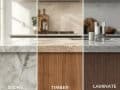
There’s a detailed guide on timber vs laminate kitchen cabinet materials on our site for consideration of the base board material performance question.
Material essentials:
- Standard MDF is unsuitable for use in wet-room applications; MR MDF is the minimum standard for the cabinet box.
- PVC door fronts provide the superior moisture resistance and most stable performance in the long run.
- Solid timber is viable but requires the right species, a sealed finish and good room ventilation.
- It is best to evaluate the baseboard material and door fronts separately rather than assume they are the same product.
Wall-Hung vs Floor-Mounted: The Practical Case for Each
Wall-hung vanities have dominated Perth bathroom design for much of the last ten years, and the reasons are as practical as they are visual. Lifting the carcass off the floor removes the cabinet from the most moisture-prone zone in the room, simplifies floor cleaning and, in bathrooms with underfloor heating, allows heat to circulate freely beneath the unit.
Floor-mounted configurations still make strong sense in specific scenarios. They carry heavier stone tops without requiring structural wall backing, offer more storage for every centimetre of bench space, and in bathrooms where the wall framing doesn’t align with where the vanity needs to sit, avoid a potentially costly structural fix.
The choice also intersects directly with your waterproofing compliance. Under the WA Building Act 2011 and the National Construction Code that Western Australia adopts as its building standard, wet areas require continuous waterproofing behind and beneath all fixed cabinetry.
Wall-hung installations need a properly waterproofed zone at each mounting point on the wall, which a good tiler co-ordinates with the cabinet and plumbing trades, but which a rushed or poorly briefed team sometimes skips.
Locking in that three-way conversation between your cabinet maker, tiler and plumber before installation begins will save you a waterproofing call-out six months after the renovation is finished.
Single vs Double Basin: When Two Isn’t Actually Better
A double basin is a luxury upgrade but is effective only if the vanity is wide enough that both basins can function well. That usually means providing at least 1500mm of bench width so that each user still has enough tap clearance, usable bench area and comfortable separation.
For many Perth bathrooms, and notably ensuites in the 1200mm to 1400mm range, a double-basin arrangement can lead to compromises rather than convenience. Rather than improving the layout, it tends to leave both basins cramped and reduces the amount of practical storage available.
When the space is tighter, one deeper basin and a well-placed drawer configuration generally have the advantage. The full-height drawer stack next to the basin, complete with at least one internally divided drawer for daily essentials, helps increase the cabinet’s utility and optimises the use of the room.
| Vanity width | Best option | Why it works |
| Under 1200mm | Single basin | Preserves bench space and allows a more practical storage layout |
| 1200mm to 1400mm | Single basin in most cases | Usually too tight for two comfortable basins and adequate tap clearance |
| 1500mm and above | A double basin can work well | Provides enough width for both basins to function properly without sacrificing usability |
Configuration and installation tips:
- Wall-hung vanities help reduce moisture exposure and make cleaning easier, but they need proper wall support.
- Floor-mounted vanities can carry heavier tops and often give you more storage.
- Double basins usually need at least 1500mm of width. In smaller spaces, a single basin is often the better option.
- Confirm waterproofing details with the cabinet maker, tiler and plumber before installation starts.
Cabinet Sizing and the Floor Space Equation
Perth bathrooms constructed before 2000 typically extend between 4m² and 6m² of usable floor space, and vanity depth directly influences how liveable the rest of the room feels each morning.
When you look at a standard carcass, it is between 450mm and 500mm deep. And stepping down to a custom 350mm shallow-depth unit recovers 100mm to 150mm of clear floor space, the difference between a room that functions comfortably and one that feels tight, regardless of how well the rest of the renovation has been done.
This is where off-the-shelf cabinetry consistently hits its limits. Standard sizes are based on standard spaces, and Perth’s newer built townhouses rarely deliver a standard-sized bathroom.
Building a custom cabinet that matches your wall-to-wall measurement with carcass depth calculated in relation to how much room you can comfortably move around will always outperform a retail unit adjusted to fit.
Hardware: Where the Daily Experience Is Made or Broken
You touch your bathroom cabinet hardware every single day, often in low light and with wet hands. Soft-close hinges are no longer a decorative bonus; they are a foundational requirement for any bathroom vanity designed to withstand heavy daily use.
The mechanism absorbs the last 20 degrees of door travel; it staves off a slam which gradually loosens hinge fixings and protects door fronts from repeated impact.
Handle selection has everything to do with the beauty and how much caring the room requires. Finger-pull or recessed handles take away the horizontal ledge where water and soap residue collect behind a bar handle, making them the cleaner solution under any wet conditions.
A brushed nickel or matte black finish hides water marks and daily contact marks far better than polished chrome, which shows every fingerprint and water droplet within hours of the room being cleaned.
What a Specialist Cabinet Maker Brings to the Bathroom
Scott Muir, managing director of Colray Cabinets and a cabinet industry professional since 2002, draws a direct connection between bathroom and kitchen cabinetry work.
“The conversations we have about bathroom cabinetry are very similar to the kitchen ones,” he says. “People think the bathroom is simpler, but the moisture and the tight footprint actually make it harder to get right.”
That depth of experience across both spaces in the same home is what helps a full-service cabinet maker co-ordinate door styles, hardware finishes and colour choices so the bathroom reads as part of the same renovation rather than a separate project bolted on afterwards.
Working from our Landsdale showroom, we regularly consult on whole-home cabinet packages where the bathroom and kitchen are resolved together.
You can see a range of finished results across different Perth suburbs in our bathroom gallery, which reflects the range of options available through a custom build.
The Compliance Side Perth Homeowners Often Overlook
WA’s Building and Energy division is explicit on the registration threshold. Bathroom renovation work valued above $20,000 that requires a building permit must be contracted and carried out by a registered building contractor, and the building commissioner has prosecuted unregistered operators in this area, with consequences that cost homeowners far more than the original renovation budget.
Cabinet installation alone rarely crosses that threshold, but a full ensuite renovation covering waterproofing, plumbing and cabinetry routinely does. Knowing the threshold before you start taking quotes means you can ask a single clarifying question of each tradesperson you bring on: Are you registered with the Building Services Board?
It also means selecting a cabinet maker who understands how their work fits with the waterproofing and plumbing order of works, because the gap between those three trades is where the majority of issues in wet rooms stem from.
Hardware, compliance and custom planning:
- Soft-close hinges should be the baseline on any bathroom vanity, not an optional upgrade.
- Recessed or finger-pull handles reduce water and residue build-up compared to exposed bar profiles.
- Brushed hardware finishes conceal water marks and wear far better than polished chrome in daily bathroom use.
- WA bathroom renovation work above $20,000 requiring a permit must involve a registered building contractor.
- A cabinet maker experienced across kitchens and bathrooms can co-ordinate finishes and hardware across the full home.
The Decision That Deserves More Thought Than It Usually Gets
The average Perth homeowner spends more time selecting tapware than choosing the vanity cabinet. It’s understandable: tapware is more photogenic, easier to compare across brands and more immediately satisfying to select.
But the cabinet is the structural backbone of the entire assembly. It is also the component most likely to fail quietly, in ways that are expensive to reverse, when the wrong materials, layout or installation order has been chosen.
The questions worth answering before you commit are straightforward.
- What is your actual usable wall width, measured to the millimetre?
- How well-ventilated is the room?
- Is this a main ensuite used by two adults daily or more of a secondary bathroom with less traffic?
- What finishes and hardware are you using elsewhere in the home, and should the bathroom cabinetry carry those through for consistency?
Taking those answers into a discussion with a specialist, rather than arriving at a showroom with a mood board and a rough number, is what produces bathroom cabinetry that performs and looks right for the long term.
If you’re currently planning a Perth bathroom renovation, what’s the one decision you’re finding hardest to resolve? Reach out to the Colray team directly to discuss your floor plan and preferred finishes.