Selecting the material for kitchen benchtops in Perth sometimes appears to be one of those decisions that will come back to haunt you if done wrong.
And honestly? It is. The benchtop is not just some surface area where vegetables are chopped or a cup of coffee is placed in the morning; it’s something that will be looked at and used almost every day for the next fifteen to twenty years, if you’re lucky.
So yeah, the pressure’s real.
Here is the fact. The debate over stone benchtops vs laminate, or whether timber should even be considered in the running, does not have to be some huge hassle.
Understanding what each material uniquely offers makes the decision much clearer.
Why Your Benchtop Choice Actually Matters More Than You Think
Look, I get it. The benchtop is just another one of a thousand decisions to be made in a new build or renovation. Tap finishes. Splashback tiles. This is where the bin goes.
But your benchtop is different.
This is the surface on which you will knead dough. This is also where someone will inevitably spill red wine; here, hot pots fresh from the oven may accidentally be placed – and likely where children sit to do homework long after a perfectly plated meal has been served.
If it’s the wrong material, it won’t just look wrong; it’ll make your life difficult in so many little ways every day. Get the right one? You barely think about it – and that’s precisely what you want.
Almost every Perth homeowner we work with, on a kitchen renovation at Colray Cabinets, brings this issue up. And rightly so. The benchtop is what sits between your budget and how aggressively you use the space every day; you might as well get it right from the beginning.
Stone Benchtops: The Heavy Hitter
Let’s start with what most people think of when they hear “premium kitchen”—stone.
Natural Stone: Granite and Marble
The appeal of natural stone is hard to deny. Each slab is totally different from the next, so you’re getting something truly unique.
Granite is extremely durable. Really hard. It takes a hot pot, it does not scratch, and if properly sealed, then staining is also never a problem.
The pattern in most granites runs from speckle to swirl – some more dramatic than others – but this allows the stone to work with almost any kitchen design.
Marble is the fancy cousin. It’s stunning – those grey and white veins are classic. But it’s more porous than granite, which means it stains easier. Red wine, lemon juice and even coffee can leave their mark if you’re not quick to wipe them up.
You’ll need to seal it regularly and give it a bit more care.
Our hot Perth summers work more for the stone in this situation. You will surely enjoy how cool the stone gets, or rather stays, even on a 40-degree day.
Engineered Stone: The Modern Alternative
Engineered stone consists of crushed quartz and resin mixed within one slab to deliver what natural stones cannot: multiple identical-looking slabs, better resistance to staining than marble, and no sealing required.
The trade-offs:
- Can’t handle high heat like natural stone – hot pots will damage it.
- No sealing required, which saves you ongoing maintenance hassle.
- Less character due to a more uniform appearance compared with natural stone.
- It can chip if you handle it roughly.
- The colour range is broader than that of natural stone.
The main drawback is its heat sensitivity. Hot pots can cause scorching or cracking, and any chipped edges are irreparable. But for Perth kitchens wanting the stone look without the maintenance, it’s a solid choice.
The Stone Reality Check
Stone benchtops, whether natural or engineered options, generally start from around $500 per square metre and upwards. If you are considering premium marble or a rare granite, then the price increases significantly.
Nor is installation a do-it-yourself job. The slabs are heavy (really heavy) and need templating, cutting, and installation by professionals. At Colray Cabinets we work with experienced stone suppliers and installers to get the measurements exactly right – there is no room for error with stone.
Structural support is not optional. Stone benchtops weigh approximately 60-70 kg per square metre, requiring safe professional installation with proper structural reinforcement.
The best stone is the one that fits how you actually use your kitchen. If you cook a lot, love hosting, and don’t want to stress about every spill, granite or engineered stone makes sense. If you desire the luxurious appearance of marble and are willing to commit to its maintenance, then go for it. Just go in with your eyes open.
Timber Benchtops: Warmth That Works
Here’s where things get interesting. Timber benchtops are not for everyone, but people who love them really love them.
Why timber?
Timber brings warmth to a kitchen. It softens the whole space. Where stone can feel cold and clinical (beautiful, but clinical), timber feels lived-in from day one. It’s tactile, it’s warm under your hands, and if properly looked after, it ages in this really lovely way, adding character rather than looking old or damaged.
Timber benchtops in Perth suit more of the coastal-style kitchen or home that is organic and relaxed. Timber benchtops work well in a beach house setting, giving off such vibes, or even something more along the lines of a modern farmhouse.
The Types You’ll See
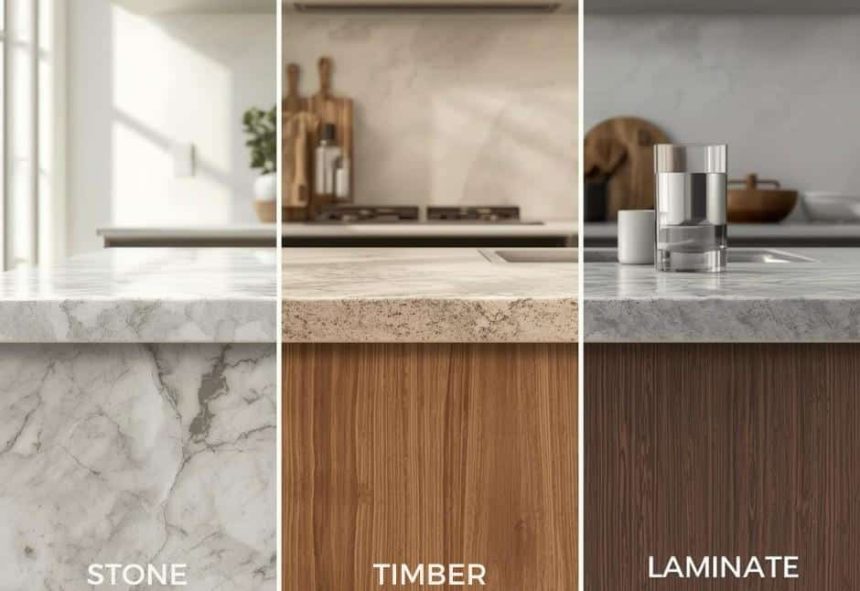
Timber benchtops are available in a few good choices of wood that work well for Perth kitchens. The most popular timbers include:
- Tasmanian Oak: An Australian hardwood timber that looks good and performs equally well. It is durable with a beautiful grain structure and takes stains and finishes quite appreciably.
- Jarrah: A local favourite! The rich, reddish-brown-toned timber is so distinctively hard to wear.
- Bamboo: Technically a grass, not timber, but used the same way. It’s sustainable, surprisingly hard, and has this clean, contemporary look to it.
Each of these timbers brings its own aesthetic appeal, and all perform well under regular kitchen use. The choice usually comes down to the look you’re after and your budget – Jarrah tends to sit at the higher end, whilst Bamboo offers good value.
Living With Timber
Here’s what nobody tells you until you ask: timber benchtops need maintenance.
You’ll need to oil or seal them every 6–12 months, depending on usage. Watermarks are a thing. Heat marks can happen. Scratches will accumulate over time. But for many people, that patina is part of the appeal. Timber develops character.
Always use trivets under hot pots on timber. Nobody is supposed to chop directly on the surface either, though some people do it anyway.
Here’s the upside: timber can be sanded back and refinished if it gets really beaten up. This isn’t an option with laminate, and refinishing stone is far more limited and costly.
Cost-wise, timber sits somewhere between laminate and stone—usually $300–$600 per square metre, depending on the species and finish.
Laminate: The Underdog That’s Better Than You Think
Let’s break the laminate thing down because there is this weird snobbish attitude toward laminate that really isn’t deserved anymore.
Not Your Grandma’s Laminate
Modern laminate bears little resemblance to products from two decades ago. The technology for manufacturing and producing laminates has taken a giant leap forward today. Manufacturers can produce laminates that convincingly imitate stone, concrete, timber, or even fabric textures. In some high-quality options, at first glance they are difficult to distinguish from the real thing.
The Practical Side
Laminate is non-porous, does not stain easily, needs no sealing, and costs $150–$400 per square metre installed. That is significantly less expensive than stone.
Indoor air quality? The substrate (particleboard or MDF) should comply with the AS/NZS 1859 series standards for low formaldehyde emissions, with E1 or E0 ratings. Most benchtops made in Australia comply, but check the cheaper imports.
The downside? It chips, scratches, cannot be repaired, and heat will damage it. Avoid using hot pots.
Laminate makes sense for light-use kitchens, rental properties, or tight budgets. It’s sensible and pragmatic, freeing up cash for other parts of your renovation.
Where Laminate Actually Shines
If you’re developing a kitchen where the benchtop is not meant to be the hero element—perhaps there is a showstopping splashback or some amazing cabinetry that needs to be shown off—laminate works perfectly in a supporting role. It is quiet and functional, letting other features take centre stage.
We have specified laminate benchtops in plenty of Colray Cabinets projects, particularly where clients wanted to invest more heavily in custom joinery or high-end appliances instead.
There is nothing wrong with that approach.
Making the Actual Decision
How do you choose among these top benchtop materials?
Begin with how you use your kitchen. Be honest with yourself. Are you preparing giant meals most nights or is it more of a coffee-and-toast situation? Your answer to that question will tell you much about yourself. If you’re getting a full kitchen design or renovation, make sure your benchtop choice works with your overall vision.
Key factors to consider:
- Budget: A full stone benchtop in a large kitchen can easily run $8,000—$15,000 or more. Timber might be $5,000–$10,000. Laminate could be $2,000–$4,000. Those aren’t small differences.
- Aesthetic: Some people see timber and immediately connect with it. Others wouldn’t have anything but stone. Trust your gut, but also look at your overall kitchen design. What makes sense with your cabinetry and splashback?
- Maintenance tolerance: How often can you go before getting annoyed at resealing the marble? That is how often you should tolerate maintenance on your benchtop.
The best benchtop material for your home will be based on how you use your kitchen, what budget restrictions there are, and personal preference regarding aesthetics. You need to answer those three questions – then picking a benchtop becomes easy.
What We See Working
From our experience at Colray Cabinets, the best results in kitchen renovations are achieved when benchtops are selected to suit the lifestyle of clients and not just their Pinterest inspirations.
Stone, particularly engineered stone, serves very well for a family that uses its kitchen heavily. It’s practical and durable, with that premium look without demanding much by way of maintenance.
Timber is great for someone who wants warmth and does not mind putting in some work to maintain it; it is suited more for character homes or relaxed coastal-inspired spaces.
Laminate is perfect for budgets that are stretched or for clients who want to prioritise spending elsewhere—maybe on better appliances or custom storage solutions in their kitchen cabinets.
There is no universally optimal choice. There’s only what’s best for you.
Wrapping Up
There is no objectively ‘best’ material for kitchen benchtops. The choice among stone, timber, and laminate should be guided by the user’s specific requirements and budget constraints, as well as by considerations of actual usage.
Stone is long-lasting and gives a premium look and feel. Timber brings in warmth besides character. Laminate is practical and offers value – each has its place.
Consider how you will be using the space within the next fifteen to twenty years. Be realistic about your budget and also about how much maintenance you are willing to undertake.
Then make a choice you can live with. If a full kitchen remodel is in the works, then this choice becomes even more important, as it will affect both your overall design and budget.
If you’re still old school and need to see these samples in person, then feel free to drop by our Landsdale showroom or give us a call at (08) 9303 4300.
We’ll run you through physical samples and help you arrive at a benchtop solution that actually makes sense for your Perth kitchen.